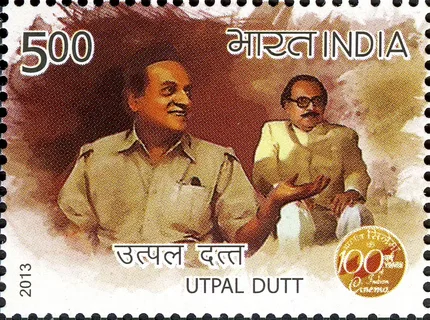
A Daughter’s Tribute: The Activist Legacy
When Utpal Dutt’s daughter, Bishnupriya, recalls her father, she doesn’t just remember the iconic comedian from Gol Maal—she remembers a man whose spirit of rebellion lives on in her. Like her father, Bishnupriya stands firmly on the side of dissent. Arrested during the JNU protests, she carries forward Dutt’s legacy of resistance, proving that his fire wasn’t just confined to the screen.
The Unforgettable Scene That Defined a Comic Genius
Ask any Indian cinephile about Utpal Dutt, and the first image that flashes in their mind is the uproarious police station scene from Gol Maal (1979). Playing the wealthy industrialist Bhavani Shankar, Dutt is mistakenly arrested by an inebriated cop who believes he’s a notorious gangster. What follows is pure comedic gold.
With his signature deadpan expression, Dutt delivers the immortal line: “You are not a police officer, you are a foolish officer!” The moment escalates into chaos as another officer recognizes Bhavani Shankar, forcing the bumbling inspector (played by Om Prakash) to sheepishly apologize. Dutt, with his wide, intense eyes, leans in—background war horns blaring—and roars, “THANK YOU!” The audience erupts in laughter.
No other actor could have pulled off that role. Dutt didn’t just play Bhavani Shankar; he became him.
From Shakespearean Stages to Bollywood Stardom
Born on March 29, 1929, in Barisal (now Bangladesh), Utpal Dutt grew up in a Bengali-Kayastha family. After schooling in Shillong, he moved to Kolkata, graduating in English Literature from St. Xavier’s College. A brief stint as an English teacher couldn’t contain his passion for theatre. By 20, he was already performing Shakespeare, and in 1949, he founded the Little Theatre Group (LTG), revolutionizing Bengali theatre.
Dutt wasn’t just an actor—he was a playwright, director, and a fierce advocate for Marxist ideology. His plays often mirrored the struggles of the oppressed, earning him both admiration and controversy. His portrayal of Othello was so powerful that it landed him his first Bengali film, Michael Madhusudan (1950).
Love, Bollywood, and the Rise of a Character Actor
While dominating Bengali theatre, Dutt fell in love with actress Shobha Sen, marrying her in 1960. Their daughter, Bishnupriya, would later become a professor at JNU—another testament to the family’s intellectual and artistic lineage.
Dutt’s transition to Hindi cinema was strategic. Bengali films offered prestige, but Bollywood promised wider reach. He made his mark in Mrinal Sen’s Bhuvan Shome (1969) and Hrishikesh Mukherjee’s Guddi (1971). Ironically, his first major Hindi film was Saat Hindustani (1969)—Amitabh Bachchan’s debut—where Dutt played the lead. The two would later share the screen in classics like Do Anjaane (1976) and Inquilaab (1984).
The Villain, The Comedian, The Romantic
Dutt’s versatility was unmatched. In Amanush (1975), he terrified audiences as a ruthless villain opposite Uttam Kumar. Yet, the same man had us in splits in Gol Maal, Naram Garam (1981), and Shaukeen (1982).
As the flamboyant, romantic old man in Shaukeen, Dutt stole the show from veterans Ashok Kumar and A.K. Hangal. Though awards eluded him for the role, audiences never forgot his charm.
A Legacy Beyond Laughter
Utpal Dutt wasn’t just an actor—he was a firebrand intellectual, a theatre revolutionary, and a man who used comedy to critique society. His daughter’s activism, his unforgettable roles, and his fearless artistry ensure that his legacy lives on.
When we remember him today, we don’t just say “Thank You” with laughter—we say it with reverence.